Saffron gets mentioned fairly often in heart-health content online, usually citing its antioxidant properties — but antioxidant activity in a lab and a measurable cardiovascular benefit in a person are two different things, and it's worth being clear about which one the actual research supports. Heart disease is a serious, common condition, and it deserves a careful, specific answer rather than a vague "superfood" claim borrowed from a supplement label. Here's what's genuinely been studied on saffron and heart health, and what hasn't.
- What Connects Saffron to Heart Health Research
- Cholesterol and Lipid Research
- Blood Pressure Research
- The Antioxidant and Inflammation Angle
- How Saffron Compares to Other Heart-Studied Spices
- What This Research Does Not Establish
- Saffron Alongside Existing Heart Conditions or Medication
- Habits With Much Stronger Cardiovascular Evidence
- How Saffron Fits Into a Heart-Conscious Diet, Realistically
- Questions Worth Asking a Cardiologist
- The Bottom Line
What Connects Saffron to Heart Health Research
The interest in saffron and cardiovascular health traces back to a few overlapping mechanisms studied mostly in laboratory and animal research: crocin's antioxidant activity, some evidence of mild anti-inflammatory effects, and preliminary findings suggesting saffron compounds may help relax blood vessels (a vasodilating effect, thought to work partly through supporting the normal function of the endothelium — the thin layer of cells lining blood vessels, which plays a role in regulating blood flow and vessel tone). Oxidative stress and chronic inflammation are both implicated in the development of atherosclerosis — the artery-narrowing process behind most heart disease, where oxidized LDL cholesterol contributes to plaque buildup in vessel walls — which is the general scientific rationale behind testing saffron in this context, rather than any single dramatic finding.
Cholesterol and Lipid Research
A handful of small human trials have measured cholesterol and related lipid markers in people taking standardized saffron extract versus a placebo. Some have reported modest reductions in total cholesterol or triglycerides, and occasionally small increases in HDL ("good") cholesterol; others have found no significant difference on any lipid marker measured. This inconsistency across a small number of trials is a meaningful limitation — it suggests any effect, if real, is likely modest rather than dramatic, and the current evidence isn't strong or consistent enough to position saffron as a cholesterol-lowering supplement with confidence. Trial durations have also generally been short, typically weeks to a few months, which doesn't tell us anything about longer-term effects on lipid levels.
Blood Pressure Research
Blood pressure research follows a similar pattern: a small number of studies, mostly short-term, have explored standardized saffron extract's effect on both systolic and diastolic blood pressure readings, with some preliminary signals of a mild reduction and others showing little meaningful change. As with cholesterol, the honest summary is "an interesting but unproven research direction," not "a demonstrated blood-pressure treatment." Blood pressure management has well-established, thoroughly studied approaches — medication when prescribed, sodium reduction, regular exercise, weight management — that sit on a much firmer evidence base than saffron currently does, and none of those approaches should be set aside in favour of an unproven supplement.
The Antioxidant and Inflammation Angle
It's worth separating "saffron has measurable antioxidant activity" (true, and reasonably well-documented in laboratory studies) from "saffron meaningfully reduces cardiovascular risk through that antioxidant activity" (not established in humans through strong clinical trial evidence). A small number of studies have looked at inflammatory markers like C-reactive protein (CRP), which is used clinically as one indicator of cardiovascular inflammation risk, with mixed results depending on dose and study population. This is a common pattern across saffron health research generally — see our pieces on saffron and blood sugar and saffron and mental health for similar examples — where a genuine laboratory finding gets stretched further in marketing language than the human clinical evidence currently supports.
How Saffron Compares to Other Heart-Studied Spices
It's useful to put saffron's cardiovascular research in context next to other spices that get similar attention. Garlic has a considerably larger and more consistent body of clinical research behind modest cholesterol and blood pressure effects, including several meta-analyses pooling dozens of trials — a meaningfully stronger evidence base than saffron currently has. Turmeric (specifically its curcumin compound) has an even larger research volume on inflammation markers, though, as with saffron, absorption and dosing questions complicate translating lab findings into reliable real-world effects. Our saffron vs turmeric vs ginger comparison covers these differences in more depth. The honest takeaway: if cardiovascular spice research specifically is what interests you, saffron is one of several candidates under study, not the frontrunner by evidence volume.
What This Research Does Not Establish
- Saffron is not shown to prevent heart attacks, strokes, or any specific cardiovascular event
- Saffron is not shown to reverse existing heart disease or atherosclerosis
- Findings on cholesterol and blood pressure are inconsistent across the small number of available trials
- Inflammatory marker research (like CRP) is preliminary and mixed, not a settled finding
- No major cardiology body currently recommends saffron as part of standard cardiovascular care
Saffron Alongside Existing Heart Conditions or Medication
If you have a diagnosed heart condition or take cardiovascular medication — including blood thinners, blood pressure medication, or cholesterol-lowering drugs — check with your cardiologist before adding standardized saffron extract specifically. This caution is less about typical culinary use, which isn't generally flagged as a specific concern, and more about higher, supplement-level doses, where the possibility of an interaction hasn't been thoroughly studied and isn't worth guessing about when real medication is involved. This matters particularly for anticoagulants like warfarin, since saffron's studied (if mild and preliminary) effect on blood clotting means the combination hasn't been well characterized, and for blood pressure medication, where stacking two blood-pressure-lowering influences without medical supervision could theoretically push readings lower than intended. A pharmacist is often a quicker, equally useful resource for this specific question if your cardiologist isn't immediately available.
Habits With Much Stronger Cardiovascular Evidence
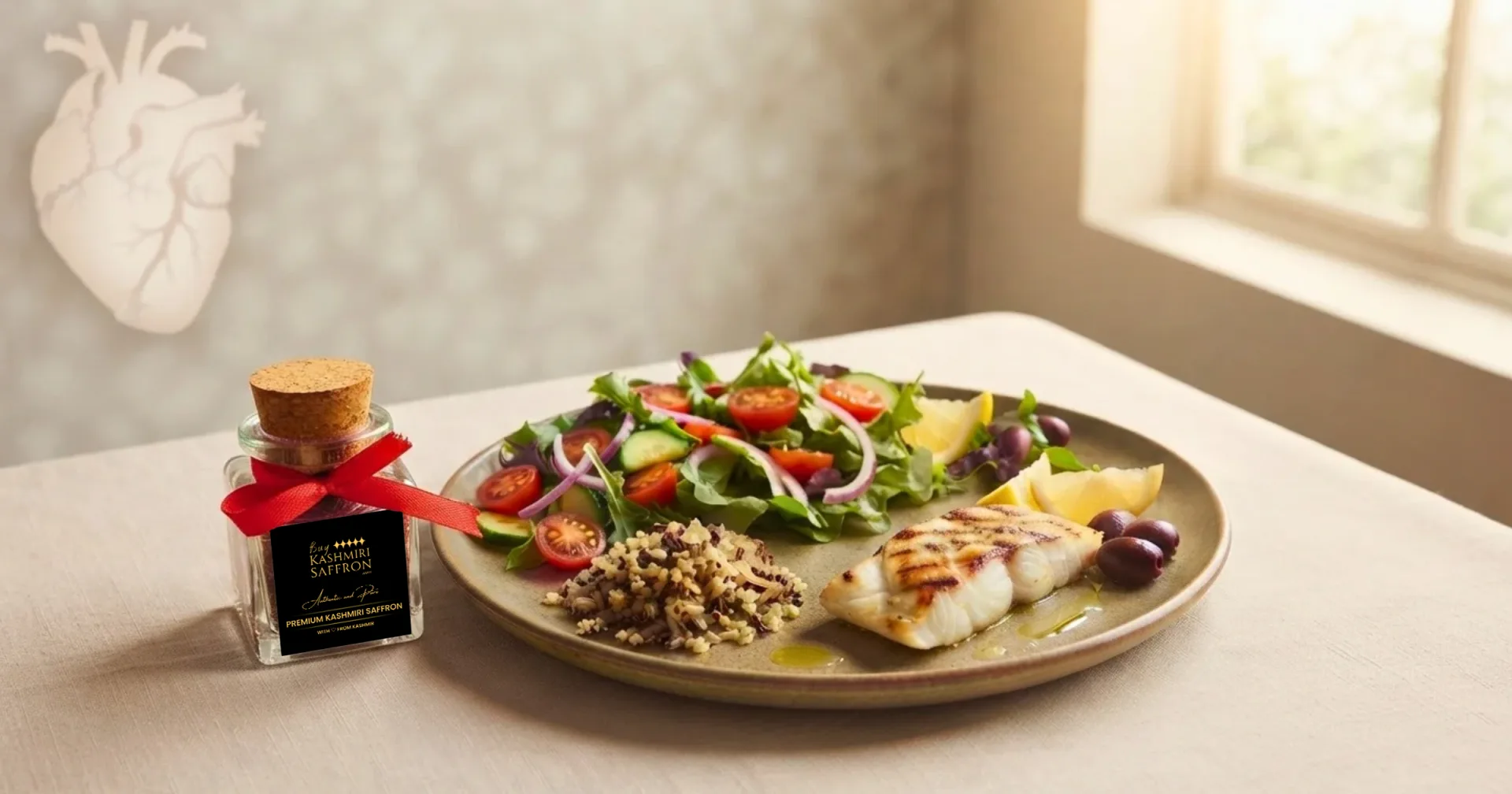
Set against saffron's preliminary research, several lifestyle factors have decades of large-scale clinical evidence behind them for heart health: not smoking, regular aerobic exercise, maintaining a healthy weight, limiting sodium and saturated fat intake, and managing stress all have substantially stronger evidence bases than any single spice or supplement. Regular physical activity in particular — something we touch on in our piece on saffron and athletic performance — has cardiovascular benefits that are well-documented across thousands of studies, dwarfing the current saffron research in both scale and consistency. Dietary patterns matter too: the Mediterranean diet specifically has a substantial, decades-long research base for cardiovascular outcomes, built on olive oil, fish, vegetables, and whole grains rather than any single ingredient. If cardiovascular health is a genuine priority, these fundamentals deserve far more attention than any supplement conversation.
How Saffron Fits Into a Heart-Conscious Diet, Realistically
None of this means saffron has no place in a heart-conscious diet — used in normal culinary amounts, it's a flavourful, low-calorie way to add colour and aroma to food without relying on excess salt or saturated fat, which is a reasonable, if modest, point in its favour as part of an overall healthy eating pattern. Swapping a cream-and-butter-heavy sauce for a saffron-infused broth or rice dish, for instance, is a genuinely sensible way to reduce saturated fat without sacrificing flavour. That's a different claim from "saffron lowers cholesterol," though, and it's worth keeping the two separate in your own thinking, even if marketing copy elsewhere doesn't bother to.
Questions Worth Asking a Cardiologist
If you're managing a heart condition and curious about saffron specifically, reasonable questions for your cardiologist include: whether standardized extract could interact with your current medication; whether your specific condition and risk profile is one where the existing (limited) research would even be relevant; whether any planned procedure or surgery means you should pause supplementation beforehand, given the studied (if mild) effect on blood clotting; and what role, if any, dietary changes should play alongside your prescribed treatment plan. A cardiologist familiar with your full history, test results, and medication list is in a far better position to answer this than general information online, including this article.
The Bottom Line
If there's one thing worth remembering from all of this, it's that "studied" and "proven" aren't the same word, even though marketing language often treats them that way. Saffron and heart health is an active but early-stage area of research, with inconsistent findings on cholesterol and blood pressure and no evidence it prevents or treats cardiovascular disease. The underlying mechanisms — antioxidant activity, possible mild vasodilation, some effect on inflammatory markers — are genuinely interesting and worth continued study, but interesting mechanisms and proven clinical benefit are two different things, and it's the second one that should guide any health decision. Don't let marketing language outrun what the actual studies show — and never adjust prescribed heart medication or treatment based on saffron research without talking to your cardiologist first.
For further reading, see the PubMed database of saffron and cardiovascular research. For genuine, lab-verified Kashmiri saffron to use in everyday cooking, see our Kashmiri Mogra saffron, and our dosage guide for sensible culinary amounts.
Please note: This article shares general food and nutrition information and is not medical advice. It is not meant to diagnose, treat or prevent any condition. If you are pregnant or breastfeeding, take regular medication, or have a health condition, speak to your doctor before changing your diet or using any food as a remedy.