Saffron on the Silk Road is a genuinely fascinating piece of trade history — the story of how a flower native to Persia and the wider Southwest Asian region eventually took root in Kashmir, where it remains one of the most prized agricultural products in the world today. This article traces that historical journey and what it means for the saffron grown in Kashmir now.
- Saffron's Earliest Origins
- The Silk Road as a Trade Network, Not a Single Road
- How Saffron Likely Reached Kashmir
- Why Kashmir Became a Saffron Heartland
- Saffron as a Historical Luxury Good
- Other Destinations Saffron Reached Through Trade
- Why Saffron Specifically Was Worth the Trade Risk
- How Saffron Corms Actually Travelled Such Long Distances
- Saffron in Religious and Ceremonial Contexts Historically
- The Legacy Today: Pampore and GI Recognition
- The Bottom Line
Saffron's Earliest Origins
The cultivated saffron crocus, Crocus sativus, is a sterile triploid plant — it doesn't produce viable seeds and can only be propagated by dividing and replanting its corms. This means every saffron crocus grown anywhere in the world today ultimately traces back, through centuries of human cultivation and corm-sharing, to an original wild ancestor species believed to have originated in and around the eastern Mediterranean and Southwest Asian region, likely domesticated somewhere in or near ancient Persia. From there, saffron cultivation spread gradually as traders, travellers, and migrating communities carried corms to new regions with suitable growing conditions.
The Silk Road as a Trade Network, Not a Single Road
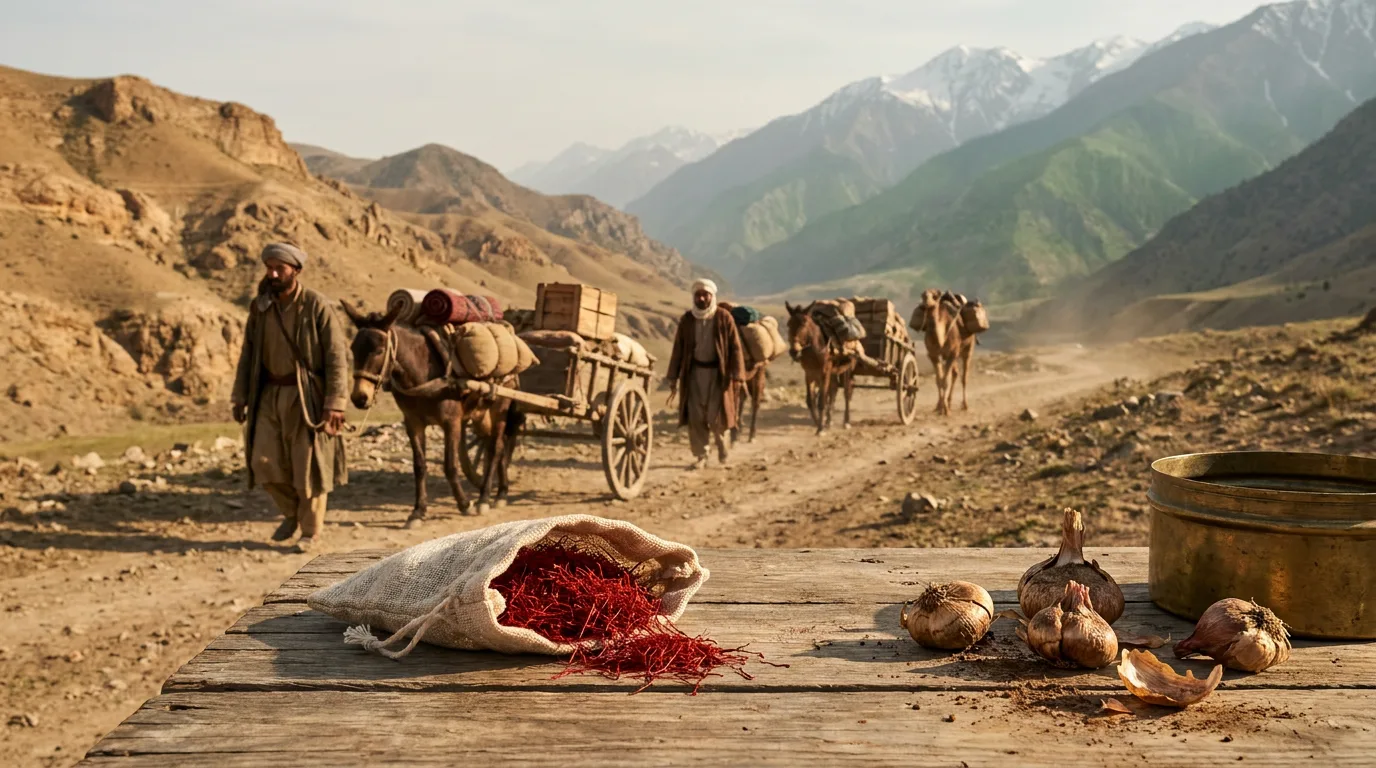
"The Silk Road" is something of a simplification — it wasn't a single road but a shifting network of overland and connected maritime trade routes linking China, Central Asia, Persia, the Indian subcontinent, and the Mediterranean world over roughly two thousand years. Goods, ideas, religions, and agricultural crops all moved along these routes in multiple directions, not just silk moving west. Saffron, prized across many of the cultures connected by this network for its colour, flavour, fragrance, and reputed medicinal properties, was one of the many valuable goods that moved through this broader trade system.
How Saffron Likely Reached Kashmir
Historians generally believe saffron reached Kashmir through a combination of trade contact and migration along routes connecting Persia and Central Asia to South Asia — the same broader network of connections often grouped under the Silk Road umbrella, alongside overland routes through what is now Afghanistan and the wider Himalayan region. Local Kashmiri tradition includes its own origin stories about saffron's arrival, some tied to Sufi saints and religious figures associated with the region's history, reflecting how deeply the crop became woven into local cultural memory rather than remaining simply an imported agricultural product.
Why Kashmir Became a Saffron Heartland
Whatever the exact historical path, Kashmir's specific growing conditions — the altitude, the particular karewa (plateau) soil formations around Pampore, and a climate with the cold winter dormancy period Crocus sativus needs to flower reliably — turned out to be exceptionally well suited to the crop. Over centuries, saffron cultivation didn't just survive in Kashmir; it became deeply integrated into the region's agricultural economy, cuisine, and cultural identity, eventually producing a grade of saffron — Mogra — recognised among the finest in the world. You can read more about this grading distinction in our guide to understanding saffron grades.
Saffron as a Historical Luxury Good
Throughout much of its trade history, saffron has been an exceptionally high-value good relative to its weight — a pattern that hasn't fundamentally changed today. This was true along Silk Road trade routes as much as it is in modern saffron pricing: the labour-intensive, hand-harvested nature of the crop, requiring three stigmas hand-picked from each individual flower during a short autumn window, has always made it costly to produce regardless of era or trade route. Historical records from various civilisations along these trade networks — Persian, Greek, Roman, and later Mughal sources among others — consistently describe saffron as a luxury commodity used in royal courts, religious contexts, and high-value trade.
Other Destinations Saffron Reached Through Trade
Kashmir wasn't the only destination saffron cultivation reached through this broader network of trade and migration. Saffron cultivation also took root, at various points in history, in parts of the Mediterranean (notably what's now Spain, particularly the La Mancha region, and Greece), reflecting how the same underlying trade and migration patterns connecting Persia to the wider ancient and medieval world carried saffron corms in multiple directions, not solely eastward toward Kashmir. Each region that successfully adopted saffron cultivation did so because local growing conditions happened to suit the plant's fairly narrow requirements — a pattern of agricultural adoption dependent as much on the right physical environment as on trade access, since not every place saffron corms reached actually a hospitable place for it to take hold and become a lasting local crop.
Why Saffron Specifically Was Worth the Trade Risk
Historical long-distance trade of this era carried real risk and cost — difficult overland routes, banditry, and the sheer logistics of moving goods across vast distances before modern transportation. That goods like saffron were still worth this risk and cost speaks to just how highly the finished product was valued relative to its weight and bulk. Saffron's combination of low weight-to-value ratio, genuine cross-cultural demand (valued similarly for colour, flavour, fragrance, and prestige across many of the civilisations connected by these trade routes), and long shelf life when kept dry made it a genuinely well-suited good for this kind of historical long-distance trade, in a way that bulkier or more perishable goods simply weren't.
How Saffron Corms Actually Travelled Such Long Distances
It's worth being specific about what actually moved along these trade routes to spread saffron cultivation, since it's distinct from the finished spice itself. Because Crocus sativus is propagated exclusively through dividing and replanting corms rather than seeds, spreading cultivation to a new region required transporting living corms, not just dried saffron threads for consumption. Corms are relatively hardy — dormant for much of the year and reasonably tolerant of being transported if kept reasonably dry and protected — which made this kind of long-distance agricultural transplantation genuinely feasible using the trade and travel infrastructure available at the time, even without modern refrigeration or rapid transport. This is worth appreciating as its own historical achievement: successfully establishing saffron cultivation in a new region required not just carrying the plant material successfully across a long journey, but a receiving community with the specific growing conditions, knowledge, and sustained agricultural commitment needed to make it take root as a lasting local crop, which is exactly what happened in Kashmir.
Saffron in Religious and Ceremonial Contexts Historically
Beyond its use as a luxury trade good and culinary ingredient, saffron has also carried genuine religious and ceremonial significance across multiple cultures along the trade routes it travelled. In various Hindu traditions, saffron-coloured cloth and pigment hold ceremonial and symbolic significance; in some Buddhist traditions, saffron-dyed robes became a recognisable marker of monastic life; and saffron has appeared in various religious and ceremonial contexts across Persian, Mediterranean, and South Asian cultures historically, often connected to its rarity, its distinctive golden-red colour, and its high perceived value. This religious and ceremonial dimension adds another layer to saffron's historical trade significance beyond pure commerce — it moved along trade routes carrying real cultural and spiritual weight in the societies that received it, not simply as a commodity.
The Legacy Today: Pampore and GI Recognition
Today, the Pampore region remains the heart of Kashmir's saffron cultivation, and Kashmir saffron received formal Geographical Indication (GI) recognition in 2020 — a modern legal framework protecting what is, in many ways, the continuation of a trade and cultivation story stretching back many centuries. You can read more about what this GI status actually means in our guide on Kashmir's GI tag for saffron. For a closer look at the modern harvesting process itself, our piece on the saffron fields of Kashmir covers what the harvest actually looks like today.
The Bottom Line
Saffron's journey from its likely Persian origins, through the broader Silk Road trade network, to becoming deeply rooted in Kashmir is a genuinely remarkable piece of agricultural and trade history — one that helps explain both why Kashmiri saffron carries such a distinct cultural weight, and why the labour-intensive, high-value nature of the crop has remained consistent across centuries of history.