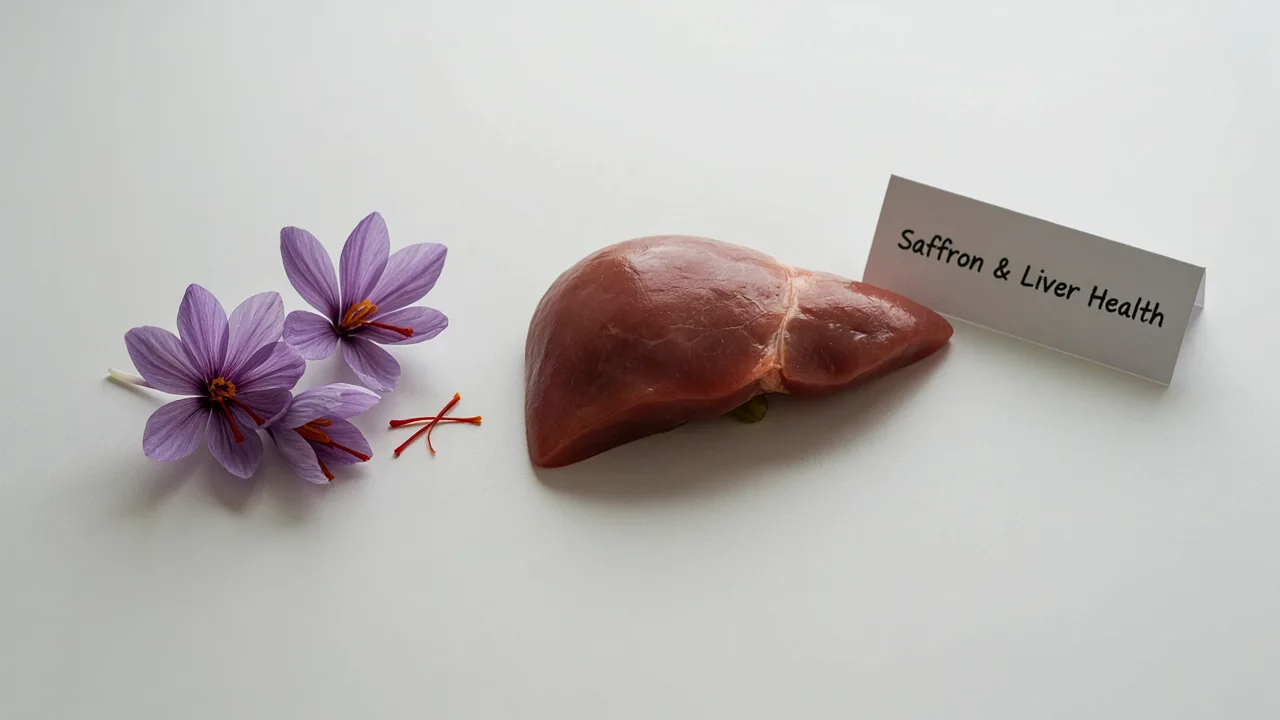
"Saffron liver detox" is a phrase you'll see in some wellness marketing, but it's worth unpacking carefully — "detox" isn't really how your liver works, and the actual research behind saffron and liver health is narrower and more preliminary than that phrase implies. If you've seen this claim attached to a saffron product and wondered whether it holds up, here's an honest look at what's actually been studied, and what the marketing leaves out.
- Why Researchers Looked at Saffron and the Liver
- What the Research Has Actually Explored
- The "Detox" Marketing Problem
- How Saffron Compares to Better-Studied Liver-Support Ingredients
- What the Evidence Does Not Show
- Saffron and Existing Liver Conditions
- The Liver and Processing Any Compound: A Relevant Caution
- Habits With Genuine Evidence for Liver Health
- Reading Liver-Related Health Claims Generally
- Questions Worth Asking a Doctor
- The Bottom Line
Why Researchers Looked at Saffron and the Liver
The liver is one of the body's main sites of antioxidant and detoxification activity in the genuine physiological sense — it's constantly processing and filtering compounds from the blood as a normal, ongoing function, breaking down everything from metabolic byproducts to medications. This made it a reasonable organ for researchers to examine when testing compounds with documented antioxidant properties in laboratory settings, including crocin and crocetin, saffron's main carotenoid compounds, since oxidative stress is understood to play a role in several forms of liver damage. The research question was specific and narrow: do these compounds show any protective or supportive effect on liver tissue under laboratory conditions, not whether saffron "detoxes" the liver in the marketing sense of the word.
What the Research Has Actually Explored
Most of the relevant research here is laboratory-based or conducted in animal models, looking at liver enzyme markers — such as ALT and AST, two enzymes commonly measured in standard liver function blood tests — and tissue changes after saffron extract exposure, often in the context of an induced liver stressor in the study design (such as a toxin or a high-fat diet model in animals). Some of these studies have reported what researchers describe as "hepatoprotective" effects — meaning the saffron-treated group showed less liver damage or more favourable enzyme markers than a control group under the same induced stress. This is genuinely interesting preliminary science, but it comes with the usual major caveat: animal and laboratory findings don't automatically translate to the same effect in humans, and well-designed human clinical trials specifically on saffron and liver health are very limited.
The "Detox" Marketing Problem
"Detox" is one of the most overused and least clinically precise terms in wellness marketing generally, not just for saffron. Your liver and kidneys already continuously filter and process your blood as a normal, automatic bodily function — there's no clinically recognized need to "detox" a healthy liver with a specific food or supplement, and no food or supplement, including saffron, has been shown to meaningfully enhance this already-ongoing process in a healthy person. When you see "liver detox" language attached to any product, including saffron, it's worth recognizing that as marketing language rather than a clinical claim with solid backing.
How Saffron Compares to Better-Studied Liver-Support Ingredients
Within the broader category of ingredients studied for liver-related properties, saffron is a relatively recent and minor entrant. Milk thistle, specifically its silymarin compound, has a considerably longer and larger research history for liver-related outcomes, including some human clinical trials, though even milk thistle's evidence is debated and not considered definitive by major medical bodies. Turmeric's curcumin has also been studied more extensively than saffron in liver-related laboratory and animal research. None of these, including saffron, have reached the point of being recommended treatments by mainstream hepatology, but it's useful context: saffron isn't even the most-studied spice in this particular corner of nutrition research, let alone a proven standout.
What the Evidence Does Not Show
- Saffron is not shown to "detoxify" a healthy liver — healthy livers don't need this in the way marketing implies
- Saffron is not a proven treatment for any diagnosed liver condition, including fatty liver disease or hepatitis
- Most supportive findings come from animal and laboratory research, not human clinical trials
- No major hepatology or liver health body recommends saffron as part of standard liver care
Saffron and Existing Liver Conditions
If you have a diagnosed liver condition — fatty liver disease, hepatitis, cirrhosis, or any other diagnosed condition — proper medical management from a hepatologist or your treating doctor is essential, and self-directed saffron supplementation based on preliminary animal research is not an appropriate substitute or addition without medical input. The liver plays a role in processing many substances, including supplements, and an existing liver condition is exactly the situation where professional guidance before adding anything new matters most. This is especially true for fatty liver disease specifically, since it's closely tied to weight, diet, and metabolic health overall — factors that deserve a comprehensive management plan, not a single ingredient treated as a shortcut around the harder, more foundational lifestyle work.
The Liver and Processing Any Compound: A Relevant Caution
It's worth connecting this to a point covered in our broader saffron side effects guide: saffron is genuinely toxic at high doses, well above typical culinary or standard supplement amounts, and the liver is among the organs involved when the body processes any compound at toxic levels. This isn't a reason to avoid normal saffron use, but it is a reason to stay within sensible, studied dosage ranges rather than assuming more must be better for liver health or any other purpose.
Habits With Genuine Evidence for Liver Health
If liver health is a genuine concern, several well-established factors have considerably stronger evidence behind them than any single spice: limiting alcohol intake, maintaining a healthy weight (given the well-documented connection between excess weight and fatty liver disease specifically), managing diabetes and cholesterol if applicable, avoiding unnecessary medication overuse, and getting recommended vaccinations and screenings for viral hepatitis where relevant. These fundamentals, guided by your doctor, matter considerably more for actual liver health than any supplement conversation, saffron included.
Reading Liver-Related Health Claims Generally
"Liver detox" and "liver cleanse" products form a large, persistently popular category in the wellness industry, worth understanding as a pattern rather than evaluating saffron in isolation from it. These products rarely cite the kind of large, well-designed human clinical trials that would meaningfully support a liver-specific health claim, relying instead on a mix of traditional use, animal studies, and the general antioxidant properties of whatever ingredient is being marketed that month. Recognizing this broader pattern makes it easier to evaluate any individual product's claims, saffron-based or otherwise, with appropriately calibrated skepticism rather than taking confident-sounding marketing language at face value.
Questions Worth Asking a Doctor
If you have liver health concerns, reasonable questions for your doctor include: what your actual liver function tests show and what they mean; whether any supplement, including saffron, is appropriate alongside your specific situation and any medication you're taking; and what evidence-based lifestyle changes would most directly help your particular case. A doctor working from your actual test results and full medical history is in a far better position to guide this than general information online, including this article, however well-sourced it tries to be.
The Bottom Line
Saffron and liver health research exists, but it's preliminary, mostly animal-based, and doesn't support "detox" marketing claims in the way they're often framed. Your liver already handles genuine detoxification on its own, continuously and without needing a dietary trigger to activate the process; saffron hasn't been shown to meaningfully enhance that process in humans, and it's not a substitute for proper medical care of any diagnosed liver condition. Treat it as what it genuinely is: a flavourful spice with some interesting preliminary research behind it, not a shortcut around the slower, less exciting work of established liver-healthy habits.
For further reading, see the PubMed database of saffron and hepatoprotective research. For genuine, lab-verified Kashmiri saffron for everyday culinary use, see our Kashmiri Mogra saffron, and our dosage guide for sensible amounts.