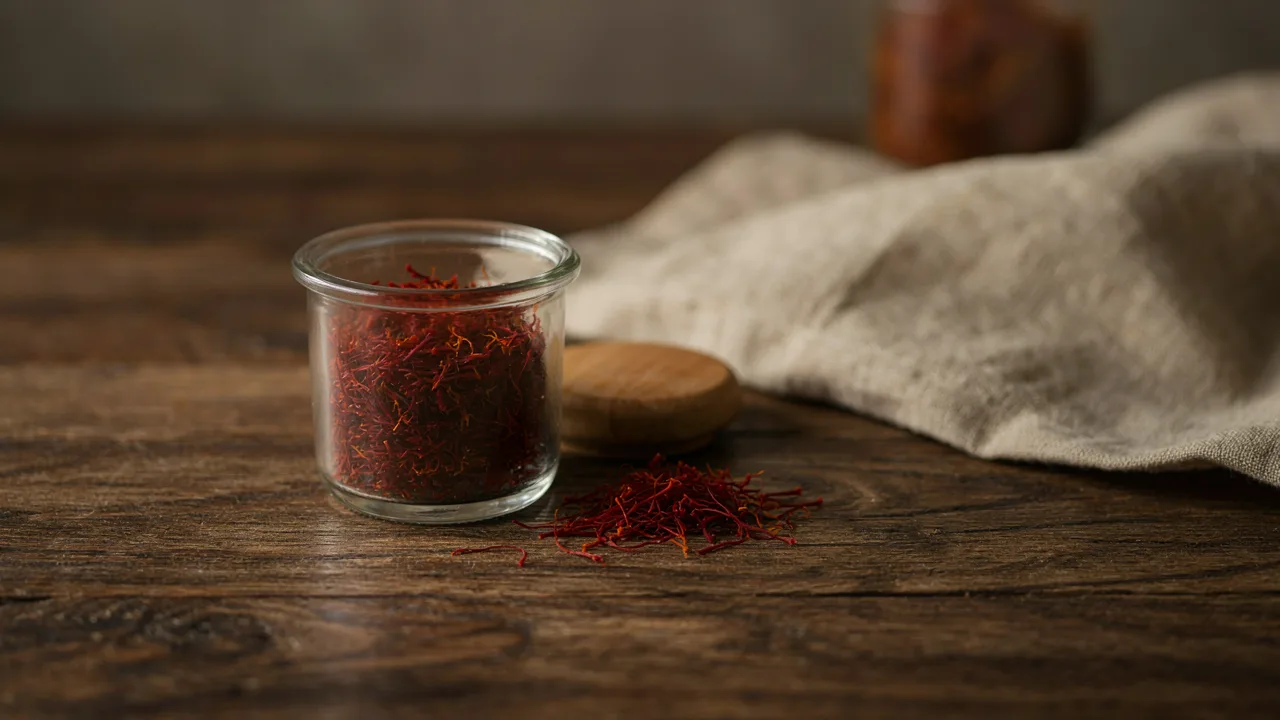
Store Kashmiri saffron in an airtight, opaque container, away from heat and light, and it will keep its potency for 2-3 years. Saffron doesn't spoil the way fresh food does — it slowly loses aroma and colour strength over time, and how you store it determines whether that happens in months or years.
Why Storage Matters More With Saffron Than Most Spices
Saffron's value comes from three compounds: Crocin (colour), Safranal (aroma), and Picrocrocin (flavour). All three are sensitive to light, heat, moisture, and oxygen — Safranal especially, since it's a volatile oil that evaporates faster than the other two. This is why a jar of saffron left open on a sunny kitchen counter can lose most of its fragrance within months, while the same saffron sealed properly in a dark cupboard stays strong for years. The saffron itself doesn't "expire" in the way milk or bread does; what actually happens is a slow, steady loss of potency, and storage conditions control how fast that decline happens.
The Four Things That Degrade Saffron
Light
UV and even regular household light break down Safranal and fade Crocin over time. This is why good saffron packaging is opaque or dark-coloured, not clear glass, and why a clear jar on an open shelf is one of the worst places to keep it.
Heat
Warmth speeds up the chemical breakdown of all three key compounds. Storing saffron near a stove, oven, or in direct sunlight will noticeably shorten its useful life. Room temperature, away from heat sources, is what you're aiming for — not the freezer (more on that below).
Moisture
Saffron threads should feel dry and slightly brittle. Moisture — from humid air, condensation, or damp hands — can cause mould or clumping, and once threads absorb moisture they degrade much faster. This is the main reason we don't recommend fridge storage: opening a cold container repeatedly in a warmer kitchen causes condensation inside it.
Air (Oxygen)
Repeated exposure to air oxidises the compounds in saffron over time. Every time a container is opened and left open, or isn't properly resealed, a little more potency is lost. An airtight seal isn't a nice-to-have — it's the single most important factor.
How to Actually Store It
- Keep it in its original sealed container if possible — ours are vacuum-sealed and light-protected specifically for this reason.
- If transferring to another container, use a small, opaque, airtight jar — dark glass or ceramic with a tight lid works well. Avoid clear glass and plastic bags.
- Store in a cool, dark cupboard — not the fridge, not near the stove, not on a sunny windowsill.
- Keep the container as full as practical. A large container with a small amount of saffron rattling around has more air inside it (and therefore more oxidation) than a smaller, appropriately-sized one.
- Use dry hands or a dry spoon every time you take saffron out — never damp fingers.
- Reseal immediately after each use. Don't leave the container open while you cook.
Should You Refrigerate or Freeze Saffron?
Refrigeration isn't necessary for normal use and can do more harm than good: taking a cold container out into a warm, humid kitchen repeatedly causes condensation inside it, which is exactly the moisture exposure you're trying to avoid. If you're storing a large bulk quantity you won't touch for a year or more, a freezer in a completely airtight, moisture-proof container can slow degradation further — but for a jar you're using regularly, a cool, dark cupboard at normal room temperature is simpler and just as effective.
Realistic Shelf Life Timeline
| Storage Quality | Noticeable Potency Loss Begins |
|---|---|
| Ideal (airtight, dark, cool, dry, minimal opening) | 2-3+ years |
| Average (resealed reasonably, kitchen cupboard) | 12-18 months |
| Poor (clear jar, near stove, left open often) | 3-6 months |
These are general ranges based on how the degradation mechanisms above behave, not a fixed expiry date — saffron doesn't become unsafe to use, it simply weakens in colour and aroma over time.
How to Tell If Your Saffron Has Faded
Old, degraded saffron isn't dangerous — it just underperforms. Signs your saffron has lost significant potency: the threads smell faint or musty rather than the characteristic honey-hay aroma; steeping it in warm milk or water produces a pale yellow instead of a deep golden-red; the threads feel unusually dry and crumble to dust instead of bending. If you're not sure whether what you have is still good, our glossary explains what Crocin, Safranal, and Picrocrocin should actually look, smell, and taste like fresh.
Common Storage Mistakes People Don't Realise They're Making
Most saffron that underperforms hasn't gone "bad" in any dangerous sense — it's simply been stored in a way that quietly drained its potency long before anyone noticed. A few mistakes come up again and again:
- Keeping it in the spice rack above or beside the stove — the single most common mistake, because that's exactly where most people keep spices, and exactly where heat exposure is worst.
- Transferring it into a decorative clear glass jar for the kitchen counter. It looks nice, but every bit of light hitting those threads is working against you.
- Using a container that's much bigger than the amount of saffron in it, leaving a large pocket of air inside that accelerates oxidation.
- Sticking a wet spoon in to scoop out a few threads — a small habit that introduces moisture over dozens of uses.
- Buying in bulk "to save money" without a real storage plan for the portion that won't be used for a year or more.
None of these mistakes make saffron unsafe — they just mean you paid for potency you never actually got to use.
Which Container Actually Works Best?
| Container | Verdict |
|---|---|
| Original vacuum-sealed, light-protected packaging | Best — designed specifically for this |
| Small dark glass jar (amber/cobalt) with tight lid | Very good alternative if transferring |
| Opaque ceramic or metal tin with a sealed lid | Good, as long as it seals tightly |
| Clear glass jar, any size | Poor — light exposure undoes your other efforts |
| Plastic zip bag | Poor — rarely fully airtight, easily crushed |
If you've already been given saffron in a clear jar, an easy fix is to keep that jar inside a second, opaque container (even a simple kitchen cupboard drawer that stays dark) rather than replacing it entirely.
Storing Saffron While Traveling or Gifting
If you're carrying saffron on a trip or giving it as a gift, the same principles apply, just in a more compact form. Keep it in its sealed original packaging until it reaches its final home rather than transferring it into a travel container along the way — every transfer is a chance for moisture or air exposure. If you're gifting saffron, mentioning basic storage guidance (dark, cool, airtight, dry hands) is a small thing that meaningfully affects how long the recipient actually gets to enjoy it at full strength.
Quick Storage Checklist
- Airtight container — sealed tight after every use
- Opaque or dark-coloured — never clear glass on an open shelf
- Cool, dark cupboard — away from the stove and direct sunlight
- Dry hands or a dry spoon only — never damp fingers
- Right-sized container — minimal empty air space inside
- Room temperature — skip the fridge unless it's a large bulk quantity in a fully sealed container
Following even most of these consistently is the difference between saffron that's still vivid and fragrant two years from now and saffron that's noticeably faded within a few months.
A Storage Tip Worth Knowing Before You Buy
Because potency fades gradually rather than the saffron simply "going off," buying fresher stock in a size you'll actually use within a year or so generally gives a better result than buying a large amount you'll be working through for years. See our full range of pack sizes if you want to match your purchase to how quickly you go through it, and our harvest season guide if you're curious about how freshly-harvested saffron compares to saffron bought later in the year.