Climate change and Kashmir saffron farming is a topic that deserves honest, specific attention — this isn't an abstract future concern for Kashmir's saffron growers, but a set of challenges already documented in yield data and farmer accounts over recent years. This article looks at what's actually happening and what it means for the crop's future.
- A Crop With Narrow Growing Requirements
- Documented Yield Challenges
- Water Availability and Irrigation
- Temperature and Flowering Timing
- Soil and Land Use Pressures
- What Farmers and Government Programs Are Doing
- Comparing to Other Climate-Vulnerable Specialty Crops
- Farmer Livelihoods and Economic Pressure
- Research and Adaptation Efforts Specific to Saffron
- Consumer Awareness and Transparent Pricing
- Is There Any Good News?
- What Individual Consumers Can Realistically Do
- What This Means for Buyers
- The Bottom Line
A Crop With Narrow Growing Requirements
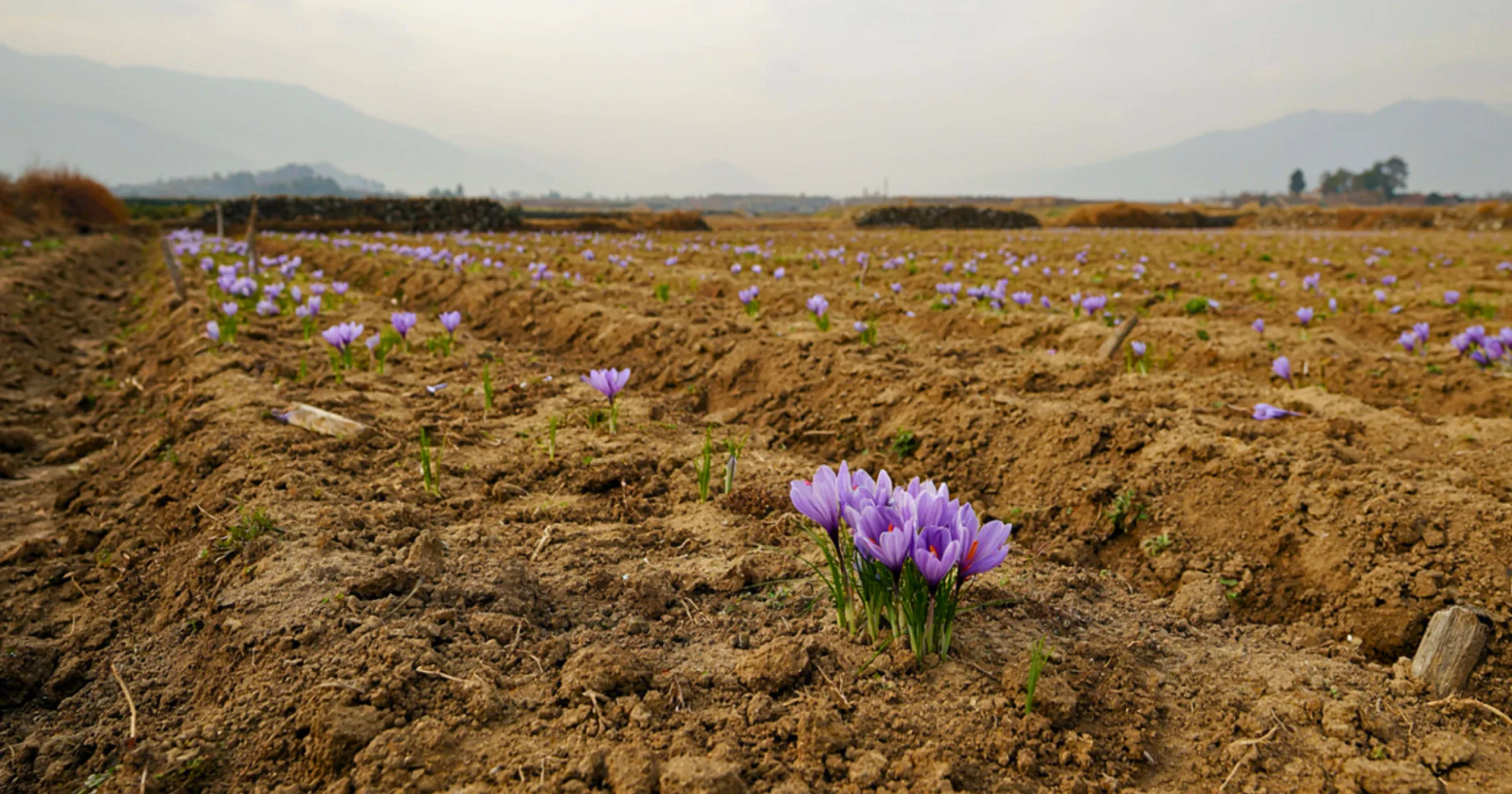
Saffron crocus (Crocus sativus) is a genuinely demanding crop in terms of growing conditions — it needs a specific combination of altitude, well-drained karewa (plateau) soil, and a distinct cold winter dormancy period followed by the right autumn conditions to flower reliably. This narrow set of requirements is exactly what made Kashmir such a naturally suited growing region historically, and it's also exactly why the crop is particularly sensitive to shifts in climate patterns compared to more adaptable crops.
Documented Yield Challenges
Various reports from agricultural authorities and news coverage over recent years have documented periods of reduced saffron yields in Kashmir, with contributing factors commonly cited including irregular or reduced rainfall, warmer average temperatures affecting the crop's flowering cycle, and declining groundwater levels in the Pampore region specifically. This isn't a single dramatic event but a pattern of gradually shifting conditions creating real, ongoing challenges for growers who depend on consistent, predictable seasonal patterns for this particular crop.
Water Availability and Irrigation
Saffron cultivation, particularly around flowering time, depends on adequate but not excessive soil moisture at the right points in the growing cycle. Reduced or irregular rainfall, combined with reported declining groundwater levels in parts of the Kashmir Valley, has created real irrigation challenges for saffron growers who have traditionally relied significantly on natural rainfall patterns rather than extensive artificial irrigation infrastructure — infrastructure that has been a focus of various government intervention programs in response to these pressures.
Temperature and Flowering Timing
Saffron crocus flowering is closely tied to specific temperature cues around the traditional October-November flowering window. Warmer, less predictable seasonal temperature patterns can disrupt this timing — flowers emerging earlier or later than the traditional window, or flowering less reliably overall — which directly affects both the quantity and timing of the harvest that depends on hand-picking flowers during their brief open window.
Soil and Land Use Pressures
Beyond climate factors specifically, saffron-growing land around Pampore has also faced pressure from urban expansion and land-use changes over recent decades, adding a compounding challenge alongside climate-related growing difficulties. Preserving the specific karewa soil formations suited to saffron cultivation, in the face of both environmental change and development pressure, has become an area of genuine concern among those focused on the long-term future of Kashmir's saffron industry.
What Farmers and Government Programs Are Doing
In response to these documented challenges, various government and agricultural initiatives have been introduced over recent years, including irrigation infrastructure investment specifically targeted at saffron-growing areas, farmer support and training programs, and research efforts focused on saffron cultivation resilience. The effectiveness and pace of these efforts varies, and this remains an active, evolving situation rather than a problem that's been fully resolved.
Comparing to Other Climate-Vulnerable Specialty Crops
Kashmir saffron isn't alone in facing these kinds of pressures — many high-value specialty agricultural products worldwide, from certain wine-growing regions to specific coffee-growing microclimates, face comparable narrow-growing-window vulnerabilities to shifting climate patterns. What tends to distinguish crops like saffron, grown in a genuinely small, specific geographic area with narrow environmental tolerances, is that there's often limited ability to simply relocate production elsewhere the way a more adaptable crop might shift growing regions over time — Kashmir's specific combination of altitude, soil, and climate isn't easily replicated at scale elsewhere, which is exactly why genuine Kashmir-origin saffron carries the distinct value and GI protection it does.
Farmer Livelihoods and Economic Pressure
Behind the yield and climate statistics are real farming families and communities in the Pampore region and elsewhere in Kashmir for whom saffron cultivation is a significant part of their livelihood, often passed down across generations. Reduced or unpredictable yields don't just affect market supply in an abstract sense — they translate directly into economic pressure on growers who depend on a successful harvest each year, which is part of why farmer support programs and continued investment in the sector's resilience matter beyond simply the question of consumer supply and pricing. Understanding Kashmir saffron farming's challenges through this human lens, not just as a commodity supply issue, is worth keeping in view alongside the more technical growing-condition factors discussed above.
Research and Adaptation Efforts Specific to Saffron
Agricultural research institutions in Kashmir and India more broadly have engaged with saffron cultivation resilience as a specific research area, exploring approaches including improved irrigation techniques suited to the crop's specific needs, corm health and disease management practices, and broader agricultural best-practice guidance for growers navigating less predictable seasonal patterns than previous generations of farmers dealt with. This research and extension work represents a genuine, ongoing effort to help the crop and the farming community adapt, even as the underlying climate pressures themselves remain outside any single intervention's ability to fully resolve.
Consumer Awareness and Transparent Pricing
As genuine climate and yield pressures affect Kashmir saffron supply, consumer awareness of these realities helps distinguish honest pricing from opportunistic exploitation of scarcity narratives. A seller being transparent that pricing reflects genuine, documented supply pressures particular to a challenging season is different from a seller using vague, unverifiable "scarcity" language purely as a sales tactic disconnected from actual market conditions. Buyers who understand the real agricultural pressures behind Kashmir saffron farming are better positioned to evaluate pricing claims critically, supporting sellers with genuine, traceable Kashmir sourcing rather than rewarding marketing built on manufactured urgency.
Is There Any Good News?
It's worth balancing this article's honest coverage of real challenges with a fair note of context: Kashmir saffron cultivation has faced difficult periods before across its long history and has persisted, and the combination of continued government and research investment, the crop's genuine and lasting global reputation and demand, and Kashmir's still-unmatched natural growing conditions for this specific crop all represent real reasons the industry's long-term outlook isn't simply one of inevitable decline. Genuine, documented challenges and a realistic path forward aren't mutually exclusive — this is an industry actively working through a difficult period, not one without prospects, and continued demand for authentic, transparently-sourced Kashmir saffron is itself part of what sustains the economic case for the investment and adaptation efforts discussed above.
What Individual Consumers Can Realistically Do
As an individual buyer, the most meaningful thing you can realistically do isn't about changing broad climate outcomes directly, but about how you buy: choosing genuinely transparent, GI-verified, lab-certified Kashmir saffron over unverified alternatives directs your spending toward supply chains that genuinely support Kashmir's saffron farmers, rather than toward mislabeled or fraudulent products that undermine both consumer trust and the real farmers this whole conversation is ultimately about. Being willing to pay a fair price reflecting genuine scarcity and labour, rather than chasing the cheapest possible option regardless of authenticity, is a small but real way individual buying decisions connect to the larger picture discussed throughout this article.
What This Means for Buyers
For buyers, these challenges are part of why genuine, transparent sourcing matters more than ever. Real climate and yield pressures are a legitimate factor affecting saffron availability and pricing — quite different from artificial scarcity used as a marketing tactic. Buying from a source that's transparent about GI-verified Kashmir origin and lab-tested purity, like our own Kashmiri Mogra saffron, is one way to support genuine Kashmir saffron cultivation rather than products that exploit the region's reputation without a real, traceable connection to it.
The Bottom Line
Climate change and Kashmir saffron farming is a real, documented, ongoing challenge — not a distant hypothetical — affecting a crop with genuinely narrow growing requirements. Understanding this honestly helps put both current saffron pricing and the importance of supporting transparent, genuine Kashmir sourcing into proper context.