Kashmir's saffron crocus flowers for just two to three weeks each year, typically from late October through mid-November — one of the shortest, most concentrated harvest windows of any spice crop in the world. Here's what that season actually looks like, and whether timing your purchase around it actually matters.
A Flower That Blooms for Barely Two Weeks
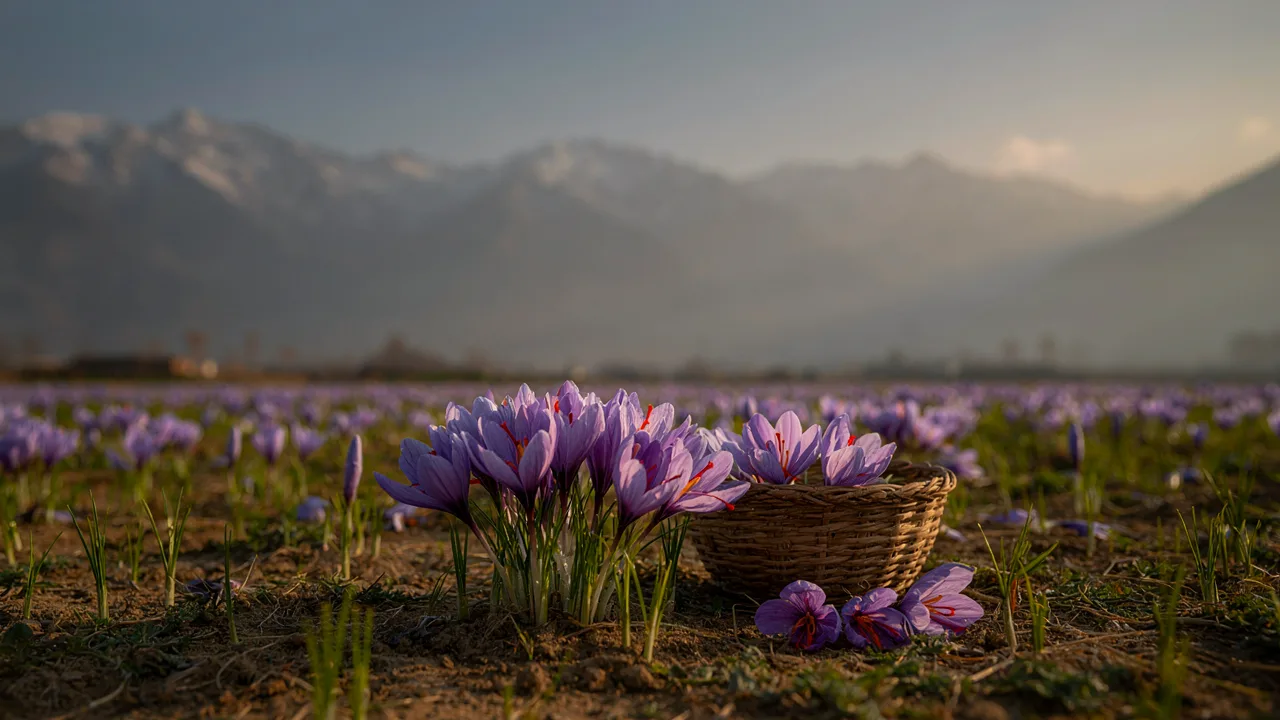
The saffron crocus (Crocus sativus) is unusual among cultivated crops: the corms (bulbs) are planted in July, August, and September, and the flowers appear roughly eight weeks later, blooming for a strikingly short window — commonly cited as around two to three weeks total, sometimes described as tightly as 15-20 days. Within that window, individual flowers open for only a day or two each before wilting, which is why the fields have to be picked continuously, flower by flower, for the entire bloom period rather than harvested all at once.
Where Kashmir's Saffron Actually Grows
More than 90% of Kashmir's saffron comes from Pampore, in Pulwama district — known as Kashmir's "Saffron Town" — with the remainder grown in parts of Budgam and Srinagar districts. Pampore's high-altitude Karewa soil (a distinctive plateau terrain unique to the region) and climate are a large part of why Kashmiri saffron develops its characteristic strength and colour. It's the same growing region we source from directly — see our Saffron Fields of Kashmir piece for more on what that land and growing process actually looks like.
What the Harvest Actually Involves
Each crocus flower contains just three stigmas — the thread-like part that becomes saffron. Flowers are hand-picked at dawn, while they're still closed and the delicate stigmas are protected from sun damage, then the stigmas are separated from the rest of the flower by hand, a slow, labour-intensive process. This is a large part of why genuine Kashmiri saffron commands a premium price: it takes an enormous number of hand-picked flowers to produce a comparatively tiny amount of usable saffron, and the entire harvest has to happen within that same short autumn window, every year, with no way to spread the labour out.
Does It Actually Matter When You Buy?
This is the practical question behind "harvest season" for most buyers: does saffron bought right after the October-November harvest taste or work better than saffron bought in, say, June? The honest answer is nuanced:
Right after harvest and proper drying, saffron is at its peak potency — full Crocin, Safranal, and Picrocrocin content, nothing yet lost to time. But saffron isn't like fresh produce that needs to be consumed within days or weeks. When stored correctly (see our full storage and shelf life guide), good saffron retains the large majority of its potency for 2-3 years. In practice, this means saffron you buy in April, processed and stored properly since the previous autumn's harvest, isn't meaningfully weaker than saffron bought in December — the difference from a few months of proper storage is negligible compared to the difference between well-stored and poorly-stored saffron.
What actually matters more than calendar timing is: was this batch processed and stored correctly since harvest, and how has it been stored since you bought it? A jar bought "fresh" right after harvest but then left open on a sunny windowsill for a year will be in worse shape than a jar bought eight months post-harvest that's been kept properly sealed and in the dark the whole time.
If You're Curious About Visiting During Harvest Season
Late October into early November, when the crocus fields around Pampore turn a striking violet-purple, is genuinely one of the most visually remarkable agricultural sights in India — worth knowing about even separate from any buying decision, if you're ever in Kashmir at that time of year. The Kashmir government also hosts an annual Saffron Festival during this window, celebrating the harvest and drawing visitors specifically to see the blooming fields.
What Happens to the Fields the Rest of the Year
Outside the brief flowering window, the Karewa lands aren't idle — the corms remain in the soil, and farmers manage the fields through the winter dormancy and into the following planting cycle, with a single corm typically productive for several years before fields are replanted. This multi-year cycle is part of why sudden yield swings from one season to the next reflect real agricultural conditions (weather, soil health, groundwater) rather than simple year-to-year randomness, and why sustained care for the land matters as much as the harvest itself.
Kashmir's Harvest in Global Context
Iran produces the large majority of the world's saffron by volume, with a much larger area under cultivation and a harvest season that broadly overlaps Kashmir's autumn window. Kashmir's output is comparatively small, but it's grown under different conditions — the high-altitude Karewa plateau soil, the specific climate of the Kashmir valley — that contribute to the distinct characteristics (deeper colour, stronger aroma) that Kashmiri saffron is known for and that earned it a Geographical Indication (GI) tag in 2020, recognising it as a product tied specifically to this region. This is also why Kashmiri saffron is priced higher than much of the saffron sold globally: a smaller harvest, entirely hand-picked, from a smaller growing area, is inherently a different scale of production than saffron grown across Iran's larger cultivated regions.
Why the Harvest Timeline Directly Explains the Price
It's worth connecting the harvest process directly to what you actually pay. A single flower yields just three stigmas, and it takes a very large number of hand-picked flowers — commonly cited at well over 150,000 flowers — to produce roughly a kilogram of dried saffron. All of that picking and separating happens by hand, by seasonal labourers, within the same two-to-three-week window every single year, with no mechanisation able to replace the delicate hand-separation step. There's no way to spread that labour cost out or scale it up quickly the way you could with a less time-constrained crop, which is the direct, unglamorous reason genuine Kashmiri saffron costs what it does — it isn't arbitrary premium pricing, it's a reflection of a genuinely labour-intensive, time-boxed harvest.
A Harvest Under Pressure
Kashmir's saffron harvest has faced real challenges in recent years — inconsistent rainfall, changing weather patterns, and groundwater depletion in the Karewa lands have affected yields in various growing seasons, a concern regularly reported on by regional agricultural authorities and news coverage. This is part of why supporting genuine, verified Kashmiri saffron (rather than cheaper look-alikes sold under the same name) matters beyond just getting a better product — it supports the actual farmers and land whose harvest is increasingly weather-dependent and labour-intensive to sustain.
How a Single Season's Weather Affects the Saffron You Buy
Because the entire harvest happens in such a narrow window, saffron quality can genuinely vary somewhat from year to year depending on that particular season's rainfall and temperature during flowering — a wetter or unusually warm bloom period can affect flower yield and, in turn, the volume (though not the fundamental safety) of that year's harvest. This is part of why lab testing every batch matters rather than assuming quality is identical harvest to harvest: a reputable seller tests and grades each batch on its own merits (ISO 3632-1 lab parameters like colouring strength, aroma, and flavour), rather than relying on a blanket assumption that "this year's Kashmir saffron" is uniformly one grade. See our certifications page for how that batch-level testing actually works.
What This Actually Means If You're Buying
Don't feel like you need to time a purchase around the October-November harvest specifically — genuine, well-stored saffron holds its quality for years, so the harvest calendar matters far less to you as a buyer than it does to the farmers doing the actual work. What matters more: buying from a source that tests and dates its batches (see our verification page to check any specific batch's lab report), and storing it properly yourself once it arrives, per our storage and shelf life guide. The harvest season is fascinating agricultural history and a real part of why genuine Kashmiri saffron costs what it does — but it shouldn't be the deciding factor in when you place an order.