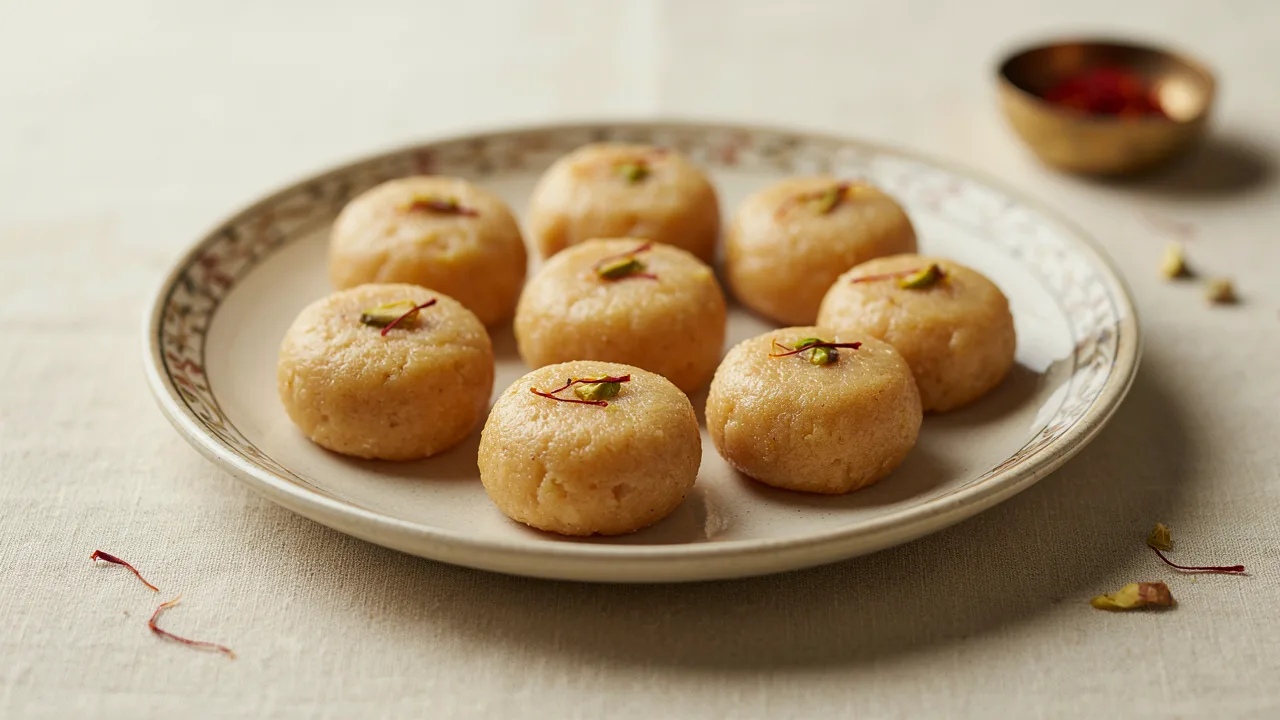
Peda is a classic Indian milk sweet made from khoya (milk solids reduced from milk), sugar, and flavourings — soft, slightly fudgy, and quick to make once you have khoya on hand. Saffron and cardamom are the traditional flavour pairing, giving the pedas their characteristic pale gold colour.
Khoya itself is the product of the same long milk-reduction process used in basundi and rasmalai, just taken further until nearly all the liquid has evaporated and what's left is a solid, crumbly mass. Buying khoya ready-made (as this recipe assumes) skips that lengthy step, which is why peda comes together so much faster than those other milk-based sweets despite sharing the same underlying ingredient.
Ingredients
- 2 cups khoya (milk solids), crumbled
- 3/4 cup powdered sugar
- 6-7 strands Kashmiri Mongra saffron
- 1 tablespoon warm milk, for the saffron infusion
- 1/4 teaspoon cardamom powder
- 1 tablespoon ghee
- Chopped pistachios, for garnish
Instructions
- Warm the milk and soak the saffron strands in it for about 10 minutes.
- Heat the ghee in a heavy pan and add the crumbled khoya, cooking on low heat while stirring continuously.
- Cook for 8-10 minutes until the khoya softens and starts to come together into a smoother mass, being careful not to let it brown.
- Add the powdered sugar and stir until fully dissolved and smooth, about 3-4 minutes.
- Stir in the saffron infusion and cardamom powder, mixing until evenly coloured throughout.
- Remove from heat and let the mixture cool until just warm enough to handle comfortably.
- Take small portions and roll into smooth balls, then gently flatten into disc shapes.
- Press a piece of pistachio into the center of each, and let them cool completely and firm up before serving.
Tips for Best Results
Low heat throughout is important — khoya can brown or become grainy quickly on higher heat, which affects both the colour and texture of the finished pedas. If the mixture feels too soft to shape once cooled, refrigerate it for 15-20 minutes to firm up before rolling.
Serving Suggestions
A traditional festival and celebration sweet, served on its own or as part of a mithai assortment.
Storage
Keeps refrigerated in an airtight container for up to a week. Bring to room temperature before serving for the best texture.